Wednesday, September 24, 2025

National Women's Health and Fitness Day


National Women's Health and Fitness Day is the nation’s largest annual health promotion event for women of all ages. The event is always held on the last Wednesday in September.

This unique national program — with participation by local organizations throughout the U.S. — focuses on the importance of regular physical activity and health awareness for women.


The goal of this event is to encourage women to take control of their health: to learn the facts they need to make intelligent health choices and to make time for regular physical activity.

Because of its grassroots nature, the event provides an excellent opportunity for local organizations to showcase the health-related programs and services they offer to women in their communities.

Some women are so busy caring for their families, and others neglect to care for themselves. On this day, remind the women in your life to improve their health and prevent disease.

It is essential for women to get regular checkups because screening tests, such as mammograms and Pap tests, can find diseases early when they are easier to treat. Some women need specific screening tests earlier or more often than others. Screenings and routine care can help women lower their risks of many health conditions, including heart disease. 

National Women's Health and Fitness Day is a public/private good health partnership organized by the Health Information Resource Center (HIRC), a national clearinghouse for consumer health information professionals.
locations. An estimated 100,000 women of all ages will participate in the 10th annual National Women's Health and Fitness Day at hundreds of community locations across the country.

More than 1,400 groups across the country will host women’s health and fitness events at senior centers, hospitals, health clubs, park and recreation districts, local health and service organizations, schools, retirement communities, houses of worship, and other communities.


Saturday, September 20, 2025

National Punch Day

FDA does not have a specific definition or standard of identity for punch, or any other requirement that a punch contains fruit juice. A punch may be an artificially flavored beverage, with or without natural flavorings, or it may be made from tea and other ingredients, exclusive of fruit juice. Such products must be clearly distinguished from products which are made from fruit juices or fruit concentrates or purees. Products containing artificial or natural flavors must be labeled in accordance with 21 CFR 101.22.


Read the Label. An educated consumer has the knowledge to make wise decisions.


Wednesday, September 17, 2025

Monte Cristo Sandwich - Make it Light


Yield: 4 sandwiches
Serving Size: 1 sandwich

Ingredients
3 tablespoons honey mustard
8 (1-ounce) slices white bread
4 (1-ounce) slices Swiss cheese
4 (1-ounce) thinly sliced smoked ham
1/3 cup fat-free milk
2 large egg whites
Cooking spray
2 teaspoons powdered sugar


Directions
1. Spread 1 teaspoon honey mustard over each bread slice.
2. Place 1 oz swiss cheese slice on each of 4 bread slices.
3. Divide ham evenly over cheese.
4. Cover with the remaining 4 bread slices, mustard sides down.
5. Combine milk and egg whites in a shallow dish. Dip both sides of each sandwich into milk mixture.
6. Heat a large nonstick skillet coated with cooking spray over medium heat.
7. Cook sandwiches for 3 minutes on each side or until lightly browned.
8. Sprinkle each sandwich with 1/2 teaspoon powdered sugar.

Thursday, September 4, 2025

National Food Bank Day - How we can make a difference?


In many ways, America is the land of plenty. But for 1 in 6 people in the United States, hunger is a reality. Many people believe that the problems associated with hunger are confined to small pockets of society, certain areas of the country, or certain neighborhoods, but the reality is much different.

Right now, millions of Americans are struggling with hunger. These are often hard-working adults, children, and seniors who simply cannot make ends meet and are forced to go without food for several meals, or even days.

It’s time to educate ourselves about the causes of hunger in America. 


Feeding America network of 200 food banks across the country are first-class organizations in the fight against hunger. They are more than just distribution centers, they are core to providing hope to the communities they serve.

The following is a summary of the information found on the Feeding America Website. 

Nearly 49 million people in America face hunger. That is 1 in 6 of the U.S. population – including more than 1 in 5 children. Don’t let their struggles go unheard. Join the Feeding America network of more than 200 food banks and Speak Out Against Hunger. 

Feeding America is the nation's leading domestic hunger-relief charity. Their mission is to feed America's hungry through a nationwide network of member food banks and engage our country in the fight to end hunger.

Feeding America provides emergency food assistance to an estimated 37 million low-income people annually, a 46 percent increase from 25 million since Hunger in America 2010.

Among members of Feeding America, 74 percent of pantries, 65 percent of kitchens, and 54 percent of shelters reported that there had been an increase since 2006 in the number of clients who come to their emergency food program sites.

Hunger can affect anyone. Feeding America has identified groups at risk, including young children, hunger in the suburbs, rural hunger, senior hunger, and the working poor.


Special on Childhood Hunger
Kate is a fictional character who represents the very situation in which many children find themselves when their parents lose their jobs. Find out how you can help.  http://www.feedingamerica.org/ways-to-give/


Childhood hunger hinders a young person's ability to learn. They are more likely to suffer from poverty as an adult. Scientific evidence suggests that hungry children are less likely to become productive citizens. Insufficient nutrition puts children at risk for illness and weakens their immune system. The immature immune systems of young children, ages 0 – 5, make them especially vulnerable to nutritional deprivation and as a result, the ability to learn, grow, and fight infections is adversely affected.


Please find out how you can help during National Food Bank Day

Friday, August 29, 2025

More Herbs, Less Salt Day and
National Lemon Juice Day

Instead of salt, use spices, herbs, lemon juice,
and/or vinegar to 
enhance the taste of your food.
The health benefits are life-long.


Wikipedia has provided an extensive list of culinary herbs and spices. The list does not contain salt (which is a mineral) or plants used primarily as herbal teas or medicinal herbs. Explore the different flavors and cultures.

Tips for Selecting and Storing
Herbs and Spices


Spice it Up with
Susan Bowerman, MS, RD, CSSD


Where does sodium come from?
Sodium comes from natural sources or is added to foods. Most foods in their natural state contain some sodium. However, the majority of sodium Americans consume comes from sodium added to processed foods by manufacturers. While some of this sodium is added to foods for safety reasons, the amount of salt added to processed foods is above what is required for the safety and function of the food supply.

Reading Labels
When you buy prepared and packaged foods, read the labels. You can tell the sodium content by looking at the Nutrition Facts panel of a food. Listed are the amount for sodium, in milligrams (mg), and the “% Daily Value.” Also read the ingredient list to watch for the words "soda" (referring to sodium bicarbonate, or baking soda), "sodium" and the symbol "Na" to see if the product contains sodium.

Salt and/or Sodium Descriptors

  • Salt-Free:  Meets requirements for "sodium-free."
  • Sodium Free: Fewer than 5 milligrams sodium per serving.
  • Very Low Sodium:  35 milligrams or less sodium per serving.
  • Low Sodium: 140 milligrams or less per serving 
  • Reduced Sodium:  At least 25 percent less sodium per serving.
  • Unsalted:  Has no salt added during processing. To use this term, the product it resembles must normally be processed with salt and the label must note that the food is not a sodium-free food if it does not meet the requirements for "sodium-free".

The FDA and USDA state an individual food that has the claim "healthy" must not exceed 480 mg sodium per reference amount. "Meal type" products must not exceed 600 mg sodium per labeled serving size.


Sodium and Hypertension.
In order for a food to make an Allowable Health Claim, it must contain a defined amount of nutrients. In relationship to sodium and Hypertension, the amount is 140 milligrams or less sodium per serving.

American Heart Association (AHA)
The American Heart Association recommends you choose and prepare foods with little or no salt to reduce the risk of cardiovascular disease. Aim to eat less than 1,500 mg of sodium per day (less than 3/4 teaspoon of salt).
The AHA is working with federal agencies to identify ways to reduce the amount of sodium in the food supply. The association is encouraging food manufacturers and restaurants to reduce the amount of sodium in foods by 50 percent over a 10-year period. AHA will help Americans lower the amount of sodium they consume by the following strategies:
 1. Reduce the amount of sodium in the food supply,
 2. Make more healthy foods available (e.g., more fruits and vegetables); and
 3. Provide consumers with education and decision-making tools to make better choices.


Tips for reducing sodium in the diet
 1.  Choose fresh, frozen or canned food items without added salts.
 2.  Select unsalted nuts or seeds, dried beans, peas, and lentils.
 3.  Limit salty snacks like chips and pretzels.
 4.  Avoid adding salt and canned vegetables to homemade dishes.
 5.  Select unsalted, lower sodium, fat-free broths, bouillons or soups.
 6.  Select fat-free or low-fat milk, low-sodium, low-fat cheeses, and low-fat yogurt.
 7.  Use spices and herbs to enhance the taste of your food. 
 8.  Add fresh lemon juice instead of salt to fish and vegetables.
 9.  When dining out, ask for your dish to be prepared without salt.
10. Don’t use the salt shaker.


Thursday, August 28, 2025

World Heart Day - Heart Heroes

Heart Heroes … people from all walks of life who are acting now to live longer, better, heart-healthy lives by making a promise:

  • A promise to our families to cook and eat more healthily
  • A promise to our children to exercise more and help them to be more active, to say no to smoking, and help our loved ones to stop
  • A promise as a healthcare professional to help patients give up smoking and lower their cholesterol
  • A promise as a policymaker to support policies that promote healthy hearts
  • A promise as an employee to invest in heart-healthy workplaces
  • A simple promise … for My Heart, for Your Heart, for All Our Hearts.


Heart health is at the heart of all health. When you look after your heart, it means eating and drinking well, exercising, stopping smoking... all the things that make you not only healthier but also feel good and able to enjoy your life to the fullest.

Cardiovascular disease (CVD) is the leading cause of death and disability in the world, killing 17.5 million people a year. That's a third of all deaths on the planet and half of all non-communicable disease-related deaths. Around 80% of these deaths are in low- and middle-income countries where human and financial resources are least able to address the CVD burden.

World Heart Day plays a crucial role in changing all of this. It is a vital global platform that raises awareness and encourages individuals, families, communities, and governments to take action now. Together we have the power to reduce the burden of, and premature deaths from, CVD, helping people everywhere to live longer, better, heart-healthy lives.


The World Heart Federation exists to prevent and control these diseases through awareness campaigns and action, promoting the exchange of information, ideas, and science among those involved in cardiovascular care, advocating for disease prevention and control by promoting healthy diets, physical activity, and tobacco-free living at an individual, community and policymaker level. There work is organized in four programme areas.
     Awareness
     Advocacy
     Applied Research
     Sharing Science and  Building Capacity

Over 70 percent of all cardiac and breathing emergencies occur in the home when a family member is present and available to help a victim.


The world’s most common cause of death. CVDs Facts and Figures


Learn the signs and symptoms of a heart attack or stroke 


Warning Signs of a Heart Attack include:

* Chest discomfort, including squeezing or pain in the center of the chest between the breasts or behind the breastbone
*  Discomfort and/or pain spreading to other areas of the upper body such as one or both arms, the back, neck, jaw or stomach
*  Shortness of breath with or without chest discomfort
Other signs include unexplained weakness or fatigue, anxiety or unusual nervousness, indigestion or gas-like pain, breaking out in a cold sweat, nausea, vomiting, light-headedness, and collapse.


Warning Signs of a Stroke include:
*  Sudden weakness of the face, arm, or leg, most often on one side of the body
*  Sudden confusion, trouble speaking or understanding
*  Sudden trouble seeing in one or both eyes
*  Sudden trouble walking, dizziness, loss of balance or coordination
*  Sudden, severe headache with no known cause
If experiencing any of these signs, which could come and go, call your emergency services/ambulance immediately.  If there is no emergency response number, seek medical attention as soon as possible.

CVD risk factors include:

Women and CVD  - Facts and Tips
Visit the World Heart Foundation for more information.


National Cinnamon Raisin Bread Day and Raisin Bread French Toast


Raisin Bread French Toast with Banana 
Topped with Crushed Gingersnap Cookie 


Recipe Resources
CDKitchen, Inc.


Monday, August 25, 2025

National Coffee Ice Cream Day - Nutrition Profile and Coffee Ice Cream Soda


Coffee Ice Cream Soda


National Tailgating Day - Food Safety Advice from the USDA

Tailgate Parties Food Safety Advice From USDA


A tailgate party is a social event held on and around the open tailgate of a vehicle. Tailgating, which originated in the United States, often involves consuming alcoholic beverages and grilling food. Tailgate parties occur in the parking lots at stadiums and arenas, before and occasionally after games and concerts. People attending such a party are said to be 'tailgating'. Many people participate even if their vehicles do not have tailgates. Tailgate parties also involve people bringing their own alcoholic beverages, barbecues, food etc. which is sampled and shared among fans attending the tailgate. Tailgates are intended to be non-commercial events, so selling items to the fans is frowned upon.


Tailgate parties have spread to the pre-game festivities at sporting events besides football, such as basketball, hockey, soccer, and baseball, and also occur at non-sporting events such as weddings, barbecues, and concerts

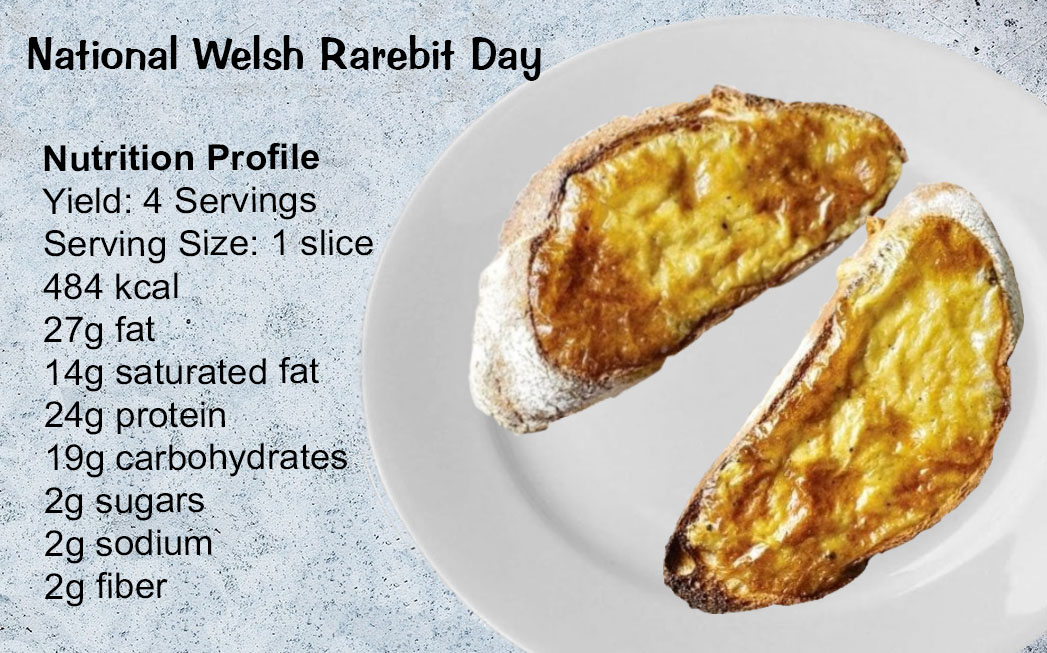
National Welsh Rarebit Day

Welsh rarebit is a dish made with a savory sauce of melted cheese and various other ingredients and served hot, after being poured over slices (or other pieces) of toasted bread, or the hot cheese sauce maybe served in a chafing dish like a fondue, accompanied by sliced, toasted bread. The names of the dish originate from 18th-century Britain. Despite the name, the dish does not actually contain any rabbit.


Welsh Rarebit - delicious. magazine  


The first recorded reference to the dish was "Welsh rabbit" in 1725, but the origin of the term is unknown.

There is some suggestion that Welsh Rabbit derives from a South Wales Valleys staple, in which a generous lump of cheese is placed into a mixture of beaten eggs and milk, seasoned with salt and pepper and baked in the oven until the egg mixture has firmed and the cheese has melted. Onion may be added and the mixture would be eaten with bread and butter and occasionally with the vinegar from pickled beetroot


Resource
Welsh rarebit, Wikipedia  

Wednesday, August 20, 2025

Lemonade Day

Lemonade Day
Do you remember the Lemonade Stands? 
Today, the children have better marketing skills.


Lemonade Day is a fun, experiential program that teaches youth how to start, own, and operate a lemonade stand. Participating cities allow youth to experience entrepreneurship each year by setting up their businesses during their city's community-wide Lemonade Day.

By teaching key analytical skills, financial literacy, and decision-making, we foster self-esteem and new mindsets that can propel youth to success. Our mission is to help today's youth become the business leaders, social advocates, community volunteers, and forward-thinking citizens of tomorrow.

How to Start a Lemonade Stand: A Guide for Kids and Parents

A lemonade stand is more than just a fun summertime tradition; it’s a wonderful opportunity for kids to explore entrepreneurship, learn valuable life skills, and connect with their community. With the support of parents, children can turn a simple idea into a meaningful experience.


Why Start a Lemonade Stand?

Starting a lemonade stand offers kids hands-on lessons in business basics, including marketing, budgeting, and customer service. Parents play a key role by offering guidance and resources, helping their children learn how to plan, problem-solve, and work toward a goal.

This activity also provides quality family bonding time and teaches core values like responsibility, perseverance, and creativity.


Benefits of a Lemonade Stand for Kids

1. Developing Entrepreneurial Skills: Kids learn to create a business plan, set prices, manage inventory, and promote their stand. These early lessons provide a strong foundation for future ventures.

2. Learning Responsibility Running a lemonade stand involves handling money, managing supplies, and serving customers—all great ways to build accountability and independence.

3. Encouraging Creativity. From designing signs to inventing new lemonade flavors, kids get to express themselves and build creative thinking skills.

4. Building Confidence. Successfully managing a stand can boost a child’s self-esteem and encourage a positive attitude toward challenges.

5. Teaching Work Ethic Children learn the value of hard work and persistence, key traits for school and life success.


Planning Your Lemonade Stand Business

Choose a Great Location. Look for areas with high foot traffic, such as parks, beaches, or outside grocery stores.

Design Your Stand and Signage: Use bright colors and fun decorations to make your stand inviting. Eye-catching signs can draw in more customers.

Decide on a Menu and Price. Offer a variety of lemonade flavors or snacks. Price your items to cover costs and allow for a small profit.

Create a Budget and Track Profits. Help your child outline the costs (cups, lemons, sugar, etc.) and calculate potential earnings. This is a great lesson in financial literacy.

Marketing and Running the Stand

Promote Your Stand: Use flyers, social media (with a parent’s help), and word-of-mouth to attract customers. Offering discounts or special deals can increase sales.

Create a Fun Atmosphere. Add music, decorations, or a theme to make your stand stand out and create a memorable customer experience.

Provide Excellent Customer Service. Teach your child to greet customers warmly, answer questions, and thank them for their support.

Handle Money Safely: Give your child opportunities to count change and track sales—important skills in budgeting and accuracy.

Maintain Cleanliness and Safety. Ensure the stand area is clean, drinks are handled hygienically, and safety rules are followed. Teach kids to be mindful of hazards and respectful of their space.


Starting a lemonade stand is a rewarding journey beyond selling drinks. It teaches kids how to set goals, work hard, and build confidence. With a little support from parents, young entrepreneurs can develop the skills and mindset they’ll carry for life.


Recipe: Raspberry Lemonade

Raspberries contain high levels of ellagic acid, a polyphenol and antioxidant being studied as a food in the fight against cancer. They are also rich in anthocyanins, a flavonoid compound that gives them their red color. Anthocyanins may help protect the circulatory, cardiovascular, and neurological systems. Raspberries are a rich source of vitamin C, manganese, and dietary fiber, and are a low-glycemic index food.


Tuesday, August 19, 2025

National Potato Day

Potatoes are one of the vegetables in the nightshade (Solanaceae) family, which includes eggplant, tomatoes, and bell peppers. It is a starchy, tuberous crop. Potatoes are the world's fourth-largest food crop, following maize, wheat, and rice.

Nutrition


One medium potato (5.3 oz) with the skin contains:
110 Calories; Vitamin C (45 % DV); 620 mg potassium; Vitamin B6 (10 % DV); No Fat; No Sodium; No Cholesterol; and Trace amounts of thiamine, riboflavin, folate, magnesium, phosphorus, iron, and zinc. 
Potatoes also contain a variety of phytonutrients that have antioxidant activity. Among these important health-promoting compounds are carotenoids and flavonoids.

About 20% of the potato’s nutrition is found in the skin.  Most of the vitamin C and potassium are found in the potato’s flesh, but fiber is found in the skin.  That’s why it’s best to enjoy every part of the potato.

According to MyPlate, Potatoes are a vegetable.  It counts toward the total recommended servings of vegetables. One medium-sized potato (5.3 oz.) counts as 1 cup of starchy vegetables.


Recipe
Rose, Gold, and Purple Potato Salad


Ingredients
5 Small Round Potatoes: 
  1 Honey Gold 
  2 Enchanted Rose
  2 Purple Splendor
Dash Curry Powder
2 tsp Dijon Mustard

1 Tbsp Italian Dressing, fat-free

Directions
1. Roast potatoes and dice.
2. In a bowl combine curry, mustard, and Italian dressing. Mix.
3. Add potatoes to the marinade and coat well.


Nutrition Information


Thursday, August 14, 2025

Remembering Julia Child


Julia Carolyn Child was born on August 15, 1912 and died on August 13, 2004. She was an American chef, author, and television personality. Child is recognized for bringing French cuisine to the American public with her cookbook, “Mastering the Art of French Cooking,” and her television programs, the most prominent of which was The French Chef, which premiered in 1963.

In 1946 Julia married Paul Cushing Child. The couple moved to Paris in 1948. In Paris, Child attended the Le Cordon Bleu cooking school and later studied privately with master chefs. She joined the women's cooking club Le Cercle des Gourmettes, through which she met Simone Beck. In 1951, Child, Beck, and Bertholle began to teach cooking to American women in Child's Paris kitchen, calling their informal school L'école des trois gourmandes (The School of the Three Food Lovers). For the next decade, as the Childs moved around Europe and finally to Cambridge, Massachusetts, the three researched and repeatedly tested recipes. Child translated French into English, making the recipes detailed, interesting, and practical.


In 1961 the Mastering the Art of French Cooking was published and became a best-seller and received critical acclaim. The book is still in print and is considered an important culinary work. Following this success, Child wrote magazine articles and a regular column for The Boston Globe newspaper. She would go on to publish nearly twenty titles under her name and with others. 

In the 1970s and 1980s, Child was the star of numerous television programs, including Julia Child & Company, Julia Child & More Company, and Dinner at Julia's. In 1989, she published a book and instructional video series collectively entitled “The Way To Cook.”

Child starred in four more series in the 1990s featuring guest chefs: Cooking with Master Chefs, In Julia's Kitchen with Master Chefs, Baking with Julia, and Julia Child & Jacques Pépin Cooking at Home.

Julia Child’s kitchen can be seen at the Smithsonian's National Museum of American History in Washington, D.C. She will be remembered for bringing French cuisine to the American public and her dynamic cooking style and presentation in the kitchen.


References.

1. Wikipedia, Julia Child
2. PBS, Julia Child
3. Julia Child's Kitchen, Smithsonian Institution


Dietitian Blog List